
Every article about Ethiopian coffee begins with the legend of Kaldi the goat herder and ends with a note about Yirgacheffe's floral brightness. That origin story, rehearsed in thousands of specialty café menu descriptions and coffee brand "about" pages, is entirely real and worth knowing. But it is not what is interesting about Ethiopia's coffee world right now. What is interesting is what is happening inside the country in 2024 and 2025: a domestic consumption revolution that is reshaping who Ethiopian coffee is produced for, a third-wave café explosion in Addis Ababa that has no equivalent in mainstream English-language coffee writing, structural reforms to the commodity exchange that are finally allowing direct farm-to-roaster traceability, and a generation of Ethiopian baristas who are competing, and winning, at the highest levels of the global specialty coffee industry.
The Domestic Consumption Shift
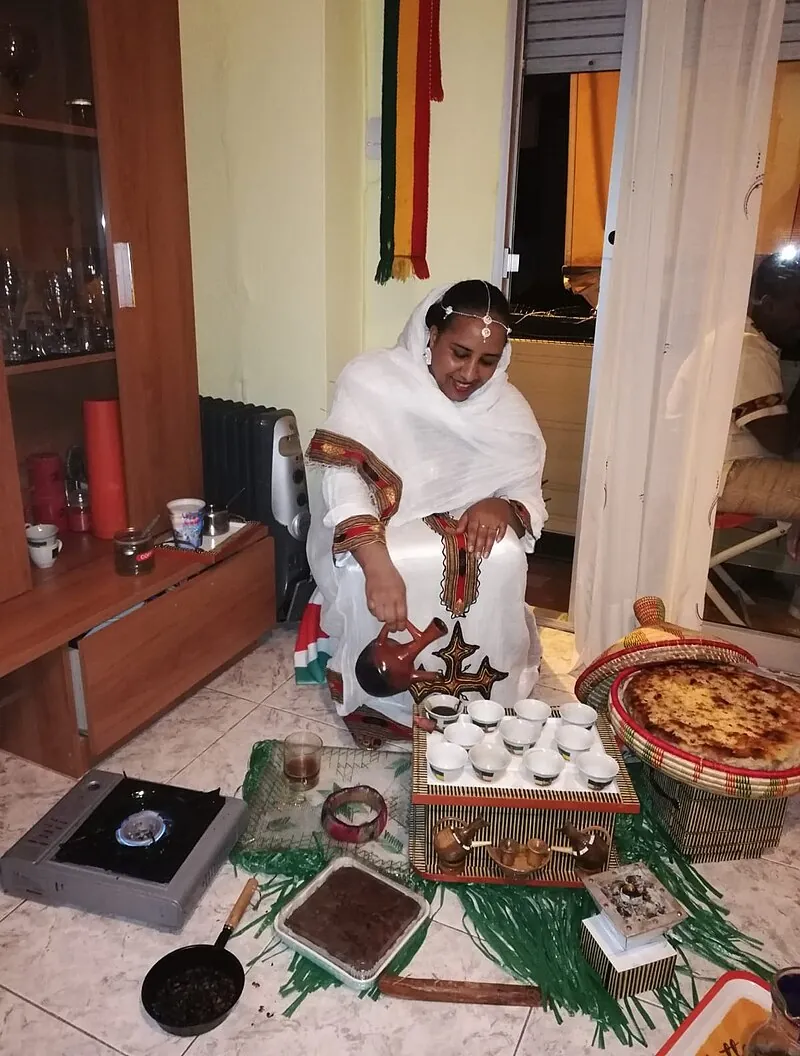
Ethiopia has always consumed a significant portion of its own coffee harvest. The traditional coffee ceremony (buna tetu), conducted three times a day in many households, is one of the world's most elaborate domestic coffee rituals: green beans are roasted over charcoal in a flat pan, ground by hand in a wooden mortar, brewed in a clay jebena pot, and served in three successive rounds (named abol, tona, and baraka) that can last up to an hour. This is not a commercial transaction; it is social infrastructure.
What has changed is the scale. A decade ago, Ethiopia consumed approximately 50% of its own coffee harvest domestically. By 2022, according to data from the International Coffee Organization (ICO) and Ethiopia's Coffee and Tea Authority (CTA), that figure had risen to approximately 65%. In absolute terms, Ethiopia consumed around 178,000 metric tons of coffee domestically in the 2022/2023 crop year, compared to exports of approximately 280,000 metric tons. Ethiopia now ranks among the top ten coffee-consuming nations in the world by total volume, which is remarkable for a country where GDP per capita remains below $1,000 USD.
This shift is driven by several converging forces: rapid urbanization (Addis Ababa's population has grown from roughly 2.5 million in 2000 to over 5 million in 2024), a growing middle class with disposable income for commercial café visits, and the emergence of a domestic specialty coffee culture that has created aspirational demand for higher-quality beans. For the first time in Ethiopia's coffee history, domestic consumers are competing with international buyers for the best lots from Yirgacheffe, Gedeo Zone, and Guji.
Tomoca and the New Addis Cafés: Two Worlds Coexisting
Tomoca Coffee, founded in 1953 by an Italian immigrant named Xenophon Yannas and located on Wavel Street in the Piazza district of Addis Ababa, is the oldest surviving commercial coffee roaster in Ethiopia. For decades it was the city's only serious espresso bar, serving a short, thick, intensely aromatic cup from a hand-cranked roaster to a loyal clientele of government workers, expats, and elderly Addis residents. The shop is small, perpetually busy, and its beans, sold in wax-paper bags to take home, have been a reliable standard for Ethiopian urban coffee drinkers since the Haile Selassie era.
Tomoca still operates. But Addis in 2024 is unrecognizable from the Addis of even 2015 in terms of its café culture. The Bole neighborhood, Kazanchis, and the area around Meskel Square now host dozens of specialty coffee shops, some locally owned, some international franchises, many staffed by trained baristas who use calibrated espresso machines, refractometers, and the vocabulary of third-wave coffee with complete fluency. Cafés like Kaldis Coffee (Ethiopia's largest domestic chain, with over 30 locations by 2024, founded in 2007), Yod Abyssinia Cultural Restaurant and Coffee, and newer specialty independents like Garden of Coffee in Bole have created a tiered café landscape that mirrors what happened in Seoul, Melbourne, and London a decade earlier.
The irony that specialty coffee culture has "returned" to the country that invented the drink is not lost on Ethiopian coffee professionals. Abraham Tekeste, a coffee importer and longtime advocate for Ethiopian specialty development, wrote in a 2023 opinion piece for the Ethiopian Herald that "we are no longer just the source; we are building the vocabulary to describe what we have always known."
The Ethiopian Commodity Exchange Reform and Direct Traceability
For years, the primary structural obstacle to Ethiopian coffee achieving its full specialty potential in international markets was the Ethiopian Commodity Exchange (ECX). Established in 2008 under Prime Minister Meles Zenawi, the ECX required all coffee exports to pass through its centralized exchange system, where beans were graded and sold by type (Yirgacheffe Grade 1, Sidama Grade 2, etc.) rather than by individual farm or cooperative. The anonymization was good for price stabilization but catastrophic for traceability. A buyer purchasing "Yirgacheffe Grade 1" might be receiving coffee from any one of dozens of washing stations across the Gedeo Zone, with no ability to establish a direct relationship with the producer.
Under Prime Minister Abiy Ahmed, who took office in 2018, the ECX rules were substantially revised. A series of regulatory changes between 2019 and 2022 created new pathways for direct farm-to-exporter and direct farm-to-roaster transactions, particularly for Specialty Grade coffees scoring above 85 points on the SCA cupping scale. Smallholder cooperatives affiliated with the Oromia Coffee Farmers Cooperative Union (OCFCU) and the Yirgacheffe Coffee Farmers Cooperative Union (YCFCU) were among the first to take advantage of these new direct-trade pathways, selling micro-lots directly to specialty roasters in Tokyo, Copenhagen, and New York without ECX intermediation.
The practical result has been a wave of traceability that was simply impossible before 2019. Roasters like Tim Wendelboe in Oslo, Heart Coffee in Portland, and Kurasu in Kyoto now publish specific washing station names, GPS coordinates, and producer names on their Ethiopian lots. For consumers, this represents a new level of coffee storytelling. For the producers, it represents higher prices: specialty-traceable Ethiopian lots routinely command $8 to $15 per pound at the roaster level, compared to $2 to $4 for ECX-anonymized commodity lots.
Ethiopian Baristas on the World Stage
The most visible symbol of Ethiopia's changing domestic coffee identity is the emergence of Ethiopian competitors at international barista competitions. The World Barista Championship (WBC), held annually under the auspices of the World Coffee Events organization, has for most of its 24-year history been dominated by competitors from Scandinavia, Australia, the United Kingdom, and South Korea. Ethiopian competitors, despite representing the world's most historically significant coffee origin, were largely absent from the podium for the first two decades of the competition's existence.
That has changed. Biruk Tesfaye, a barista affiliated with Metad Agricultural Development PLC, an Ethiopian specialty coffee company that grows, processes, and exports its own coffee from the Hambela estate in the Guji Zone of Oromia Region, competed at the 2023 World Barista Championship in Athens and drew significant attention from the international specialty coffee community for both his technical precision and his deliberate choice to present Ethiopian-grown and Ethiopian-roasted coffee in his competition routine. Metad's model is vertically integrated from farm to cup, a rarity in African coffee: they grow coffee at approximately 1,900 to 2,200 meters altitude, process it at their own washing stations, roast in Addis Ababa at their own facility, and export finished roasted product alongside green beans.
The significance of an Ethiopian barista presenting Ethiopian-roasted coffee at the WBC cannot be overstated for the domestic industry. It is a direct challenge to the assumption, embedded in the commodity export model, that Ethiopia's role is to produce raw material and export it for value to be added elsewhere. Metad and its baristas represent a different argument: that the best Ethiopian coffee, roasted by Ethiopians with intimate knowledge of the bean, can compete on the world stage as a finished product.
Challenges That Remain
The story is not one of unqualified progress. Ethiopia's coffee sector faces structural challenges that no amount of third-wave enthusiasm can resolve quickly. Climate change is affecting the traditional growing altitudes: a 2017 study in Nature Plants (Davis et al.) projected that up to 60% of current Ethiopian wild coffee habitat could become unsuitable by 2100 under high-emission scenarios, with the Kaffa region, considered the geographic origin of Coffea arabica, among the most vulnerable. Smallholder farmers, who produce approximately 95% of Ethiopia's coffee on plots under 2 hectares, remain structurally vulnerable to price volatility despite the new direct-trade pathways.
Infrastructure for quality preservation post-harvest remains uneven. Drying beds, water access for washed processing, and cold-chain storage for finished green coffee are distributed inconsistently across growing regions. A Yirgacheffe cooperative with strong international buyer relationships may have state-of-the-art raised drying beds and digital moisture meters; a smallholder in West Hararghe may dry coffee on bare soil with no technical support. The specialty revolution has benefited the best-connected producers significantly, but the baseline has not risen uniformly.
Why This Matters for the Global Specialty World
Ethiopia produces approximately 7 to 10% of the world's coffee by volume but arguably a disproportionate share of the world's most distinctive-tasting coffee by flavor profile. The Yirgacheffe washed naturals, the Guji anaerobic naturals, the Harrar dry-processed lots with their wild blueberry notes: these are reference points for what coffee can taste like at its most expressive. The country's biodiversity advantage is extraordinary: the Kaffa region alone contains more genetic diversity within the Coffea arabica species than exists in the entire rest of the coffee-growing world, according to USDA estimates. This genetic reservoir is, in the medium term, one of the most important assets available to coffee breeders developing disease-resistant and climate-adapted varieties.
For specialty coffee drinkers and professionals outside Ethiopia, the developments of the past five years represent an invitation: not just to buy a bag of Yirgacheffe from a local roaster, but to follow the supply chain back to a named washing station, a named farm, a specific harvest year, and a specific producer family. That level of connection was structurally impossible a decade ago. It is increasingly normal now, and it is happening because Ethiopians are demanding it for themselves first.
Related: Colombian Coffee Regions Explained | Fair Trade vs Direct Trade: What the Labels Mean | Coffee Processing Methods: Washed, Natural, Honey