Every cup of coffee in the world — whether it is a third-wave single origin from a Brooklyn roaster or an instant sachet from a gas station — traces its lineage to one place: the highlands of Ethiopia. The story of how coffee moved from wild forest trees in southwestern Ethiopia to the cups of eight billion people is one of human history's great flavour journeys. And Ethiopian coffee, at its finest, remains the standard by which all other origins are judged.
The Legend of Kaldi
The origin myth of coffee is Ethiopian. Around the 9th century CE, so the story goes, a goat herder named Kaldi noticed his flock becoming unusually energetic after eating berries from a certain tree. He brought the berries to a local monastery; the monks made a drink from them and found it kept them alert during long evening prayers. Whether historically accurate or not, the story encapsulates something real: coffee was discovered in Ethiopia, in the wild forests of the Kaffa region, and its stimulant properties were the starting point of its global spread.
The word coffee itself likely derives from "Kaffa" — the southwestern Ethiopian province where wild Coffea arabica still grows beneath the forest canopy.
Wild Coffee Forests: A Living Origin
Unlike any other major coffee origin, Ethiopia still has wild coffee forests where coffee trees grow without human cultivation. In the Kaffa Biosphere Reserve, the Sheka Forest, and the Harenna Forest of Bale Mountains National Park, coffee grows as it has for millennia — in multi-layered forest ecosystems with extraordinary biodiversity.
These wild forest coffees represent a genetic treasure: Ethiopian coffee has more genetic diversity than any cultivated coffee in the world. This biodiversity is the insurance policy of global coffee — if climate change or disease threatens the narrow genetic pool of commercial Arabica varieties, Ethiopian wild coffee genes may hold the solutions.
The Key Regions and Their Flavour Profiles
Yirgacheffe
The most celebrated Ethiopian coffee region — a small zone within the larger Gedeo Zone of southern Ethiopia. Yirgacheffe coffees, particularly when washed (wet-processed), are among the most distinctive in the world: bright, clean, with unmistakable jasmine, bergamot, lemon, and blueberry notes. The altitude (1,700–2,200m), the ancient heirloom varieties, and the washing station processing combine to produce something genuinely unlike any other coffee. A well-sourced washed Yirgacheffe is often the "revelation cup" that converts people from commodity coffee to specialty.
Sidama (Sidamo)
The broader zone surrounding Yirgacheffe. Sidama coffees share some of Yirgacheffe's floral and citrus character but with slightly more body and earthiness. The Guji sub-region has recently emerged as a distinct designation, with some of Ethiopia's most complex natural-process coffees — dried with the fruit intact for a winey, fruit-forward result.
Harrar (Harar)
From the ancient walled city of Harar in eastern Ethiopia, these are dry-processed (natural) coffees with a wild, rustic character — blueberry, dark fruit, wine, and spice. Harrar coffee is grown by smallholder farmers on small plots, often intercropped with khat (a stimulant plant also widely consumed in the region). The processing is artisanal and the results variable — at their best, Harrar coffees are extraordinary; at their worst, inconsistent. Part of the romance.
Limu & Jimma
Western Ethiopian coffees with more earthiness and less of Yirgacheffe's brightness — well-balanced, often used in espresso blends.
The Ethiopian Coffee Ceremony: Coffee as Ritual
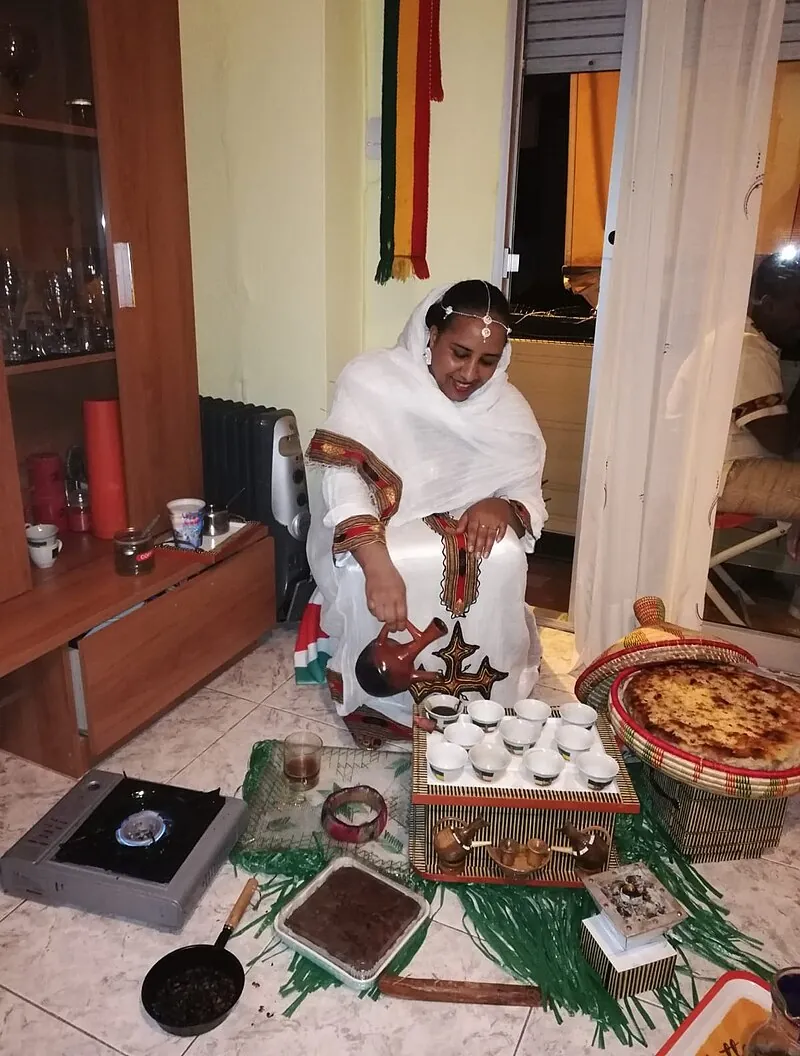
In Ethiopia, coffee is not a beverage — it is a social institution. The traditional coffee ceremony (bunna tetu in Amharic) is one of the world's great ritual food experiences:
- Fresh green coffee beans are roasted in a flat pan over charcoal, filling the room with smoke and fragrance
- The roasted beans are ground by hand in a mortar
- The grounds are brewed in a traditional clay pot called a jebena
- Coffee is poured from height into small handleless cups (cini), often served with sugar or salt, sometimes with popcorn or bread
- Three rounds are served: the first (abol) is the strongest; the second (tona) medium; the third (baraka, "blessing") the lightest
Refusing an invitation to a coffee ceremony is considered impolite. The ceremony can last two hours. That is not a long time to share something that took 1,000 years to travel from a forest in Kaffa to a cup in your hands.
Ethiopia's Coffee Economy
Coffee accounts for approximately 30–35% of Ethiopia's total export earnings — making it not just a cultural but an economic cornerstone of one of Africa's most populous nations. Around 15 million Ethiopians depend on coffee farming for their livelihoods. The country consumes roughly half of what it produces domestically — a sign of how central coffee is to daily Ethiopian life.
How to Buy Ethiopian Coffee
Look for bags that specify the region (Yirgacheffe, Guji, Sidama, Harrar) and the processing method (washed vs. natural). Single-origin Ethiopian coffees from specialty roasters who can trace the supply chain to specific washing stations or cooperatives offer the most authentic experience. For the floral washed profile: medium roast or lighter. For the fruit-forward natural: slightly darker roast or enjoy the winey sweetness at a light-to-medium roast.
Related: Top 10 Coffee Producing Countries | What Makes Specialty Coffee Different?