Germany is not the first country that comes to mind in global coffee conversations. Italy dominates discussions of espresso, Japan attracts attention for pour-over precision, and Ethiopia holds cultural primacy as the birthplace of coffee. Yet Germany is one of the world's largest coffee-consuming nations by volume. In 2022, Germany imported approximately 1.1 million metric tons of green coffee, second only to the United States among importing nations, and Germans consume an average of around 162 litres of coffee per person per year, according to the German Coffee Association (Deutscher Kaffeeverband). That figure exceeds German per-capita beer consumption. The dominant form of all this coffee is not espresso or cold brew or any of the formats that global café culture discusses with enthusiasm. It is filter coffee, brewed at home, drunk from a large mug, often accompanied by cake, in the afternoon. The tradition has a name: Kaffee und Kuchen, and it is more deeply embedded in German daily life than most food writing in English acknowledges.
What Kaffee und Kuchen Actually Is
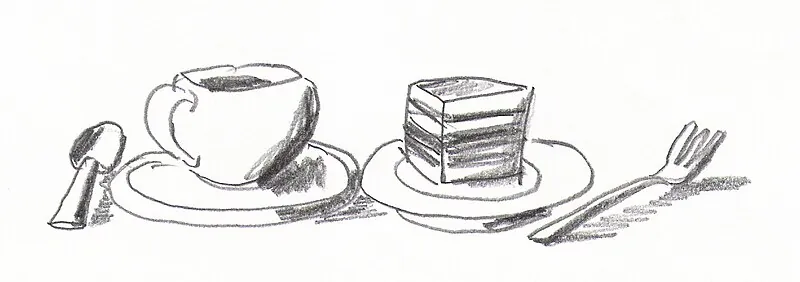
Kaffee und Kuchen (coffee and cake) is the German equivalent of British afternoon tea, occupying the same approximate time slot, the mid-afternoon, usually between 3pm and 5pm, and fulfilling the same social function: a pause in the day that occasions gathering, conversation, and something sweet. It is not a formal meal. It is not a restaurant experience in most households. It is, far more commonly, a domestic ritual, conducted around the kitchen or dining table, with a pot of filter coffee and whatever cake is available, often homemade.
The most traditional cakes associated with Kaffee und Kuchen include Bienenstich (bee sting cake, a yeast dough filled with vanilla cream and topped with caramelised almonds), Streuselkuchen (yeasted dough with a crumble topping), Schwarzwälder Kirschtorte (Black Forest cake, layers of chocolate sponge, kirsch-soaked cherries, and cream), and Apfelkuchen (apple cake in various regional forms). These are not delicate pastries. German Kaffeekuchen tends to be substantial, filling, and built to accompany a full pot of coffee rather than a small cup. The correlation between portion size and the large-format filter coffee that accompanies it is not accidental.
Sunday Kaffee und Kuchen is the most formal version. In many German families, Sunday afternoon is the occasion for extended family to gather, and a freshly baked cake or one from the local Konditorei (pastry shop) marks the occasion. The Konditorei, distinct from the bakery, specialises in cakes, tortes, and pastries and often includes a small café where Kaffee und Kuchen can be consumed on-site. These establishments have been under economic pressure from supermarket cake sections and changing habits since the 1990s, but they remain a visible part of German town centres, particularly in smaller cities.
The Historical Roots: Coffee Arrives in Germany
Coffee reached German-speaking territories in the mid-seventeenth century. The first German coffeehouse opened in Hamburg in 1677. By the early eighteenth century, coffeehouses had established themselves in Leipzig, Berlin, and other commercial cities. Leipzig's Café Baum, established around 1694, is one of the oldest continuously operating coffee establishments in Europe and today functions as a coffee museum as well as a café.
Johann Sebastian Bach, who lived and worked in Leipzig from 1723 to 1750, composed the Coffee Cantata (BWV 211) around 1734, a comic secular cantata in which a father attempts to prevent his daughter from drinking coffee. "Without my coffee I cannot live," sings Lieschen, the daughter, in a line that a coffee-drinking nation has found endlessly quotable across three centuries. The cantata is a social document as much as a musical one: coffee was fashionable, addictive, and being argued about in eighteenth-century Germany in terms that a modern coffee drinker would recognise.
Friedrich the Great of Prussia issued a series of coffee restrictions between 1777 and 1781, attempting to redirect German consumers toward beer and protect domestic grain interests against the foreign commodity coffee represented. He deployed soldiers as "coffee sniffers" who were authorised to seek out and report illegal home coffee roasting by its aroma. The restrictions were eventually abandoned as unenforceable. The episode illustrates how embedded coffee had become in German life within a century of its arrival.
Filter Coffee Dominance: Why Germany Never Switched to Espresso
The postwar period saw Italy develop its espresso bar culture and France its café crème tradition, while Germany retained and deepened its attachment to filter coffee. The reasons are practical and historical. German domestic coffee culture had been built around the pot and the family table, not the street-level bar. The Melitta company, founded by Melitta Bentz in Dresden in 1908, invented the paper coffee filter and the filter cone, originally patented under her name. Bentz's company standardised and commercialised the filter coffee system throughout the German market over the following decades, and the Melitta brand remains a dominant domestic name. The paper filter became infrastructure: German households were built around it.
Espresso equipment requires a different physical setup, a different coffee grind, and a different sensibility. The German preference for a larger volume of coffee, enough to fill a large mug rather than a small demitasse, maps naturally onto filter coffee and awkwardly onto espresso. Germany has a thriving specialty coffee scene in Berlin, Hamburg, and Munich, with excellent espresso bars, and younger Germans consume espresso-based drinks readily, particularly in urban environments. But the national baseline remains filter coffee, and the statistics on home consumption confirm it. The German Coffee Association reports that filter coffee constitutes approximately 63 percent of all coffee consumed in Germany.
East Germany and the Coffee Crisis of 1977
One of the most remarkable episodes in the history of coffee in any country occurred in the German Democratic Republic (East Germany) in 1976 and 1977. Green coffee prices spiked globally following a catastrophic frost in Brazil in 1975 that destroyed much of the harvest and sent world market prices to unprecedented levels. For the GDR, which imported all of its coffee and paid for it in hard currency that the command economy struggled to generate, this became a genuine crisis.
The East German government's response was to introduce Mischkaffee (mixed coffee), a product that blended real coffee with substitutes including chicory, rye, sugar beet, and other materials, at a ratio of approximately 51 percent real coffee to 49 percent substitute. This product was sold at the standard price in place of real coffee, without prominent labeling indicating its substitute content. The public reaction was one of the sharpest expressions of popular discontent in the GDR's history. Mischkaffee was mockingly nicknamed "Erichs Krönung" (Erich's Crown Blend), a sardonic reference to Erich Honecker and the West German Jacobs Krönung brand, which remained unavailable to ordinary East Germans.
The episode became a meaningful illustration of daily-life consequences of the system's economic limitations. Access to real coffee was a persistent aspiration among East German citizens, and West German coffee was a standard component of care packages sent across the border. When reunification came in 1990, one of the first observed shifts in East German consumer behavior was a rapid movement toward West German coffee brands. Jacobs Krönung, already symbolically loaded, saw significant sales gains in the former East.
The German Specialty Coffee Scene Today
Berlin has developed a credible specialty coffee scene since the 2000s. The city's low rents during the post-reunification period allowed small independent operators to experiment, and a cluster of serious coffee shops established themselves in Mitte, Prenzlauer Berg, and Kreuzberg. The now-closed but influential Café Rosa in Berlin and the ongoing work of roasters like The Barn, founded in 2010 and shipping globally, helped position Berlin as a European specialty coffee capital alongside London, Oslo, and Melbourne.
The Barn operates multiple locations in Berlin and is known for its light-roast, single-origin approach and transparency about sourcing. It is a representative example of how Germany's younger generation of coffee professionals has engaged with third-wave principles while operating within, and alongside, a country whose coffee identity remains rooted in the filter pot and the Sunday afternoon Konditorei.
The coexistence of these two coffee worlds, the Kaffee und Kuchen tradition that is as domestic and ordinary as a family table, and the single-origin light-roast Berlin café that could be in Brooklyn or Tokyo, is not a contradiction. It reflects the genuine range of a country that has consumed coffee in serious quantities for three hundred and fifty years and developed multiple cultural contexts for doing so.
Related: The Viennese Coffeehouse: A UNESCO-Listed Institution | Specialty Coffee in Scandinavia: Why Oslo and Helsinki Lead the World